
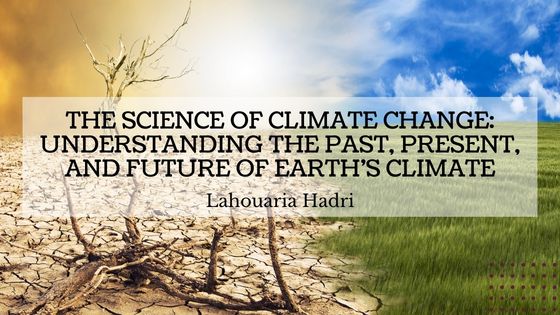
Climate change is one of the most complex and pressing scientific challenges of the 21st century. It affects ecosystems, economies, human health, and geopolitical stability. While discussions around climate change often enter political and social debates, at its core, climate change is a scientific phenomenon governed by well-understood physical, chemical, and biological processes. Understanding these processes is essential for making informed decisions about the future of our planet.
This article explores the science of climate change by examining Earth’s climate system, the role of greenhouse gases, human influence, observed impacts, and future projections.
Understanding Earth’s Climate System
Earth’s climate is regulated by a delicate balance between incoming solar radiation and outgoing heat energy. The planet receives energy from the Sun, primarily in the form of visible light. Some of this energy is reflected back into space by clouds, ice, and reflective surfaces, while the rest is absorbed by land, oceans, and the atmosphere.
The absorbed energy warms the Earth, which then emits heat in the form of infrared radiation. Certain gases in the atmosphere trap some of this outgoing heat, preventing it from escaping into space. This natural process, known as the greenhouse effect, keeps Earth warm enough to support life. Without it, the planet’s average surface temperature would be approximately –18°C instead of the current ~15°C.
Greenhouse Gases and Their Role
Greenhouse gases (GHGs) include carbon dioxide (CO₂), methane (CH₄), nitrous oxide (N₂O), water vapor, and ozone. Each gas differs in its ability to trap heat and its persistence in the atmosphere.
-
Carbon dioxide is released through natural processes such as respiration and volcanic activity, but also through human activities like burning fossil fuels and deforestation.
-
Methane is more effective at trapping heat than CO₂ over short timescales and is emitted from agriculture, landfills, and fossil fuel extraction.
-
Nitrous oxide comes primarily from agricultural fertilizers and industrial activities.
Since the Industrial Revolution, atmospheric concentrations of these gases have increased dramatically. Carbon dioxide levels, for example, have risen from about 280 parts per million (ppm) in the 18th century to over 420 ppm today — a level not seen in millions of years.
Human Influence on Climate Change
Scientific evidence overwhelmingly shows that human activity is the dominant driver of modern climate change. The burning of coal, oil, and natural gas releases vast amounts of CO₂ into the atmosphere. Deforestation reduces the number of trees available to absorb CO₂, further amplifying the problem.
Climate scientists use multiple lines of evidence to attribute warming to human causes, including:
-
Temperature records from land, ocean, and satellites
-
Ice core data revealing historical greenhouse gas concentrations
-
Climate models that simulate Earth’s response to different variables
When models include only natural factors such as volcanic eruptions and solar variability, they fail to explain the observed warming. When human greenhouse gas emissions are added, the models closely match real-world temperature trends.
Observed Impacts of Climate Change
The effects of climate change are already visible across the globe. These impacts are not uniform; they vary by region and ecosystem.
Rising Global Temperatures
The global average surface temperature has increased by approximately 1.2°C since pre-industrial times. While this may seem small, even minor shifts in average temperature can lead to significant environmental changes.
Melting Ice and Rising Sea Levels
Glaciers and polar ice sheets are melting at unprecedented rates. As ice melts and seawater expands due to warming, global sea levels rise. This threatens coastal communities, low-lying islands, and critical infrastructure.
Extreme Weather Events
Climate change increases the frequency and intensity of extreme weather events such as heatwaves, droughts, hurricanes, and heavy rainfall. Warmer oceans fuel stronger storms, while higher atmospheric moisture leads to more intense precipitation.
Ecosystem Disruption
Many species struggle to adapt to rapid temperature changes. Coral reefs experience bleaching due to warmer waters, while shifting climate zones force plants and animals to migrate, often unsuccessfully.
Feedback Mechanisms in the Climate System
One of the most concerning aspects of climate change is the presence of feedback loops — processes that can amplify warming.
-
Ice-albedo feedback: As ice melts, darker land or water surfaces absorb more heat, leading to further warming and more melting.
-
Permafrost thawing: Frozen soils contain vast amounts of methane. As permafrost melts, methane is released, accelerating warming.
-
Ocean warming: Warmer oceans absorb less CO₂, leaving more greenhouse gas in the atmosphere.
These feedbacks make climate change more difficult to reverse and increase the urgency of mitigation efforts.
Climate Modeling and Future Projections
Climate scientists use sophisticated computer models to project future climate scenarios based on different emission pathways. These models consider atmospheric chemistry, ocean circulation, ice dynamics, and biological processes.
Future projections depend heavily on human choices. If greenhouse gas emissions continue at current rates, global temperatures could rise by 3–4°C by the end of the century. Such warming would likely cause irreversible damage to ecosystems and human societies.
Conversely, rapid reductions in emissions could limit warming to around 1.5–2°C, significantly reducing the severity of impacts. Achieving this goal requires a transition to renewable energy, improved energy efficiency, sustainable agriculture, and large-scale carbon removal strategies.
The Role of Science in Addressing Climate Change
Science plays a critical role not only in understanding climate change but also in developing solutions. Advances in renewable energy technologies, battery storage, carbon capture, and climate-resilient agriculture offer pathways toward mitigation and adaptation.
Equally important is climate science communication. Clear, evidence-based information helps policymakers, businesses, and individuals make informed decisions. Education and international collaboration are essential for addressing a problem that transcends national borders.
Conclusion
Climate change is not a distant threat — it is a present-day reality grounded in well-established scientific principles. The physics of greenhouse gases, the chemistry of the atmosphere, and decades of observational data all point to the same conclusion: human activity is reshaping Earth’s climate at an unprecedented rate.
While the challenges are immense, the science also offers hope. By understanding how the climate system works, humanity can take meaningful action to reduce risks, protect ecosystems, and ensure a sustainable future. The choices made today will determine not only the climate of tomorrow but the legacy left for generations to come.